Tuesday, 5 November 2013

Above and Below


Sir David Attenborough was once questioned.....

"Where in the UK offers the best opportunity to capture magnificent nature?"

His answer was... "The Farne Islands during the breeding season in spring would be my favourite"

When a man like Sir David Attenborough say's something like this it puts a chill down my spine as I get to see it every year, so you can never take it for granted and I never will. 

The Farne Islands are renowned for it's magnificent wildlife with the thousands and thousands of seabirds that use the Farnes to bring their young into this world, but if it was not for what is BELOW the water things would be alot different ABOVE the water.

If it was not for all the sandeels that are around the Farne Islands the seabirds would either not survive or have to adapt some other way.

We hear in the news that global warming is destroying our planet and that the waters around the world are warming up, but I can assure you the waters around the Farnes have never risen one little bit. Yes you might get a day when it feels a little warmer a bit warmer but that does not happen very often. Why do you think all the divers that come to this area wear dry suits, because it's bloody freezing.

This is why the sandeels love our waters as they don't like warm waters and this is great news for our seabirds. They also love our seabed as it is perfect for them with the gravelly sand in which they can hide from predators until they come out and then our grab seabirds them so they can feed their young.

They are very important sauce of food for our seabirds and there is talk in Scotland where seabird numbers have declined to make Marine Protected Areas so that they can look after the sandeels.

At the bottom of our food chain is Seaweed or Kelp, which provides a food source for lots of species from tiny plankton to large fish and seals. 
The cracks and nooks around the base of the kelp are also perfect for small worms, crustaceans and sandeels to burrow into. Kelp is also grazed upon by fish, seals and other invertebrates such as blue-ray limpet. The seals tend to use it more of a playground, as the swim around it like it was the Krypton Factor. (Oh boy I'm showing my age now).


As you can see from the pictures above that the seals love the kelp but it also can provide shelter for other species to.

Again the kelp does not like warm water only cold and the threat of global warming could alter the distribution of kelp, or potentially become too warm for it to survive. The effect of loosing kelp in our waters would cause for a ripple up affect on other species dependent upon kelp.
In addition, our kelp forests play a hugely important role in the carbon cycle of our planet, capturing 75% of the net carbon fixed annually in the sea. Our seas and sea life are quite literally our life source, helping to regulate oxygen and carbon dioxide in the atmosphere, providing us with air to breathe.

We all know everything goes around in circles and everything is put on this earth for a reason, so lets hope our waters do not warm up around the Farne Islands as it will have a massive affect on us and our wildlife.   

I don't really want to think about that as this blog is supposed to show you all the good things and show you that the wildlife is just as beautiful underwater as it is above.

Yes that's a young me and a young bud looking at a diver coming to the surface many moons ago. The Jellyfish is called a Lions-main and boy they can sting, but you just have to put up with the pain for a while then it goes away. 


Anyway, when the sandeels come out of the gravelly sand they swarm in big balls and they can be spotted by the seabirds above and the the feeding frenzy begins. Again we are lucky as we tend to see loads of frenzies around the Farnes so here are a few pictures.


This was a shoal of sandeels going along and I noticed a Shag come from underneath it to grab an early lunch


Some bigger sandeels.


A Razorbill with a few tiny sandeels in it's bill


 The food source around the Farne Islands helps our seabirds but it also helps other birds like the Gannet which travels down from the Mighty Bass Rock and this year we have had a record amount of Minkie Whales in the area. Yes we have had a good year for mackerel but if they are not there they will take sandeels to.

The wide variety of underwater wildlife is fantastic around the Farne Islands. You can see everything thing from Sea-urchins to Nudibranchs.

We have lots of shipwrecks around the Farnes and they can make the perfect place for them to start making their own reefs and starting new life. Lots of wrecks support creatures such as seamats, starfish, a rainbow of multicoloured sea slugs, mysid and edible pink shrimps and a multitude of crabs. Nudibranchs, commonly known as sea slugs are often seen by divers exploring the marine environment. The name "nudibranch" comes from the Latin, nudus, naked, and Greek brankhia, gills. Almost all sea slugs have gills on their bodies, which provide a 'fluffy' looking appearance. Sea slugs are incredibly diverse and can live anywhere from the shore to depths of 80metres. They are a wide range of colours, often resembling the colouration of the habitat they live on or are brightly coloured, in an attempt to warn off predators.

I could go on and on but I think I have gone on a bit to much now so here is a few pictures of what can be seen underwater around the Farne Islands.

A close up of an Anemone


 Brittle Starfish


 Common Starfish


 Sun Starfish


 Hermit Crab


 Plumrose


 Deadmans Fingers


 Octopus


 Deadmans Fingers, Sunstar, and Sea-urchin


 Wrasse


 Cone Jellyfish


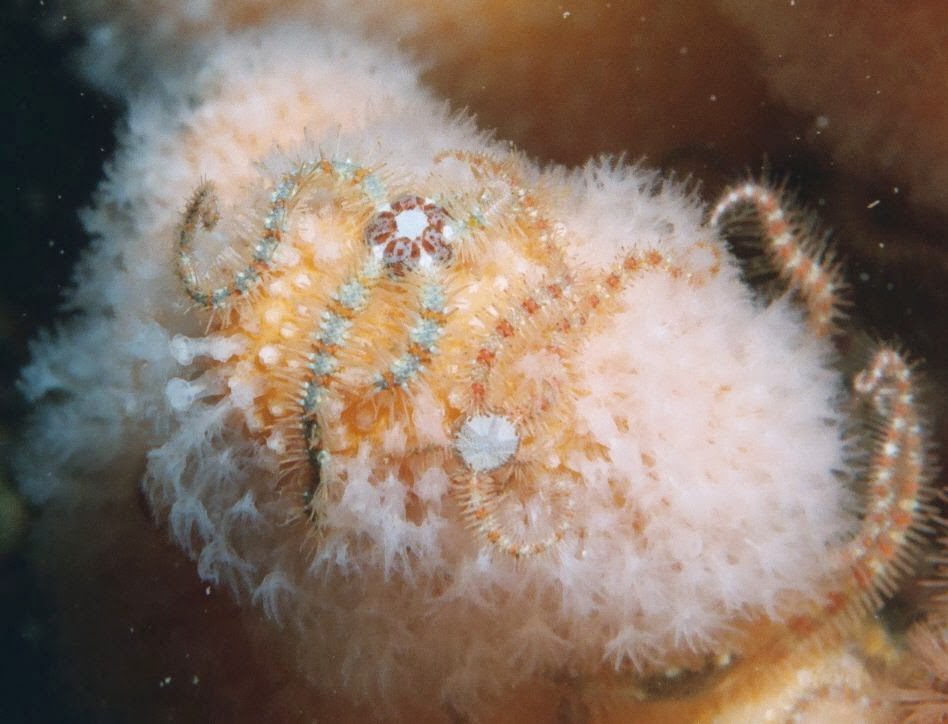
 Diamond Brittlestars

 Dragnet


 Moon Jellyfish


 A Wall of Anemone


 Pipe Fish


As you can see by the pictures above the wildlife BELOW the water is just beautiful as ABOVE and this is one of the reasons divers come from far and wide to dive the Farne Islands, but not only that they also come to see the inquisitive Grey Seals.

I just hope and pray that the waters around the Farne Islands do not warm up for the wildlife's sake, ours and many generations to come.

I'm going to sign out of this blog with a really stunning video, which was given to me from one of my brother's (Toby) divers this summer and I do hope you enjoy it.
 
I would advise you to adjust it to your full screen as it's much better.


Friday, 11 October 2013

Seal Pup Trips


The seal season is now underway with a few pups born already.

We are delighted to offer you a chance to see the pups up close with a landing trip onto Staple Island. This trip will be 2.5 hours long with 1 hour on the Island.

You will be guided by the National Trust staff around the Island giving you a talk about the seals and what they do to look after the seals. They will also take you close to the new born pups where you will get the opportunity to get a photograph or two.

This trip is only in it's second year so it's a great chance to come along and join us.

The price of the trip is £13 an Adult and £9 a Child and this is for your boat. You will also have to pay a landing fee of £10 an Adult and £5 a Child and this is payable to the National Trust on the Island. If you are a member of the National Trust you will still have to pay the landing fee as this is a special event.

We have limited spaces on the boats and only one boat is allowed on the Island at one time.

PLEASE NOTE
The Island will only be open when we have our first seal pup and the most important thing is the welfare of the pups. We will also only be able to land if the weather is good.
Please wear good shoes as you will be walking on rough ground. Warm clothes are a must at this time of the year and please don't forget your camera's or you will regret it.

You have to remember this is a special event and the seal pups are the most important thing. We are on their Island so please don't stray away from the group.

OUR SAILING TIMES

Monday 14th, departing at 12pm 
Tuesday 15th, departing at 11am and 1pm
Wednesday 16th, departing at 12pm
Thursday 17th, departing at 11am and 1pm
Friday 18th, departing at 12pm
Saturday 19th and Sunday 20th departing at 2pm
Monday 21st, departing at 11am and 1pm
Tuesday 22nd, departing at 12pm
Wednesday 23rd, departing at 11am and 1pm
Thursday 24th, departing at 12pm
Friday 25th, departing at 11am and 1pm
Saturday 26th and Sunday 27th, departing at 2pm
Monday 28th, departing at 1pm
Tuesday 29th, departing at 11am and 1pm
Wednesday 30th, departing at 1pm and
Thursday 31st, departing at 11am and 1pm

To book please call 01665 721667 or 01665 720760 or 07984668093


Friday, 4 October 2013

Greenland Shark

The Greenland Shark, also known as a Gurry Shark or a Grey Shark washed up our shores this morning. It was found this morning at daylight on the beach at Dunstan Steads/Embelton.

I received a phone call from my crewman Andy telling me that a Shark was on the beach, so I jumped into the van with my camera and my trusty dog Bud and drove across to the site. It only takes about 10 minutes to get the but it felt like ages as I had never seen a shark for years was getting really excited.

It's a lovely walk down to the beach and you pass through the golf course past Dunstanburgh Castle then onto the beach and their it was dead on the beach.

Just by the look of it, it had not been dead for long as some of the blood was dripping from it and just a slight smell. I don't know how it died but nothing looked wrong with it. No marks to say it had been hit by a boat. No rope marks or cuts, just one of its eye's had popped out. I'm hopeing it was natural causes but what on earth was it doing in our waters as it's from the North Atlantic Ocean around Greenland and Iceland.

I have to confess that I did touch it and it was really smooth from it's head to tail but the other way it was rough. It felt a little bit like leather. It's teeth were very small and they were facing the same way. As I touched them they were very blunt but saying that I still would not like to have my hand there if it was alive.

I felt really sorry for it to be honest. It looked sad and I am praying it did die of natural causes.

I also meet two people from the National Trust and they said that they dragged it up the beach so it did not get washed away as it was going to Newcastle to be frozen.

A local farmer that had been surfing came along to give us a hand to get the shark of the beach and into a van so they could take it away. He came up with a great idea and it worked a treat but I was very surprised how light it was. Just by looking at it I thought it would be the same weight as a cow seal but I was very wrong.  I think we were all pleased it was light as it might have been a bit of a struggle getting it to the van.  We also took a guess that it was 9ft long.

Hopefully I will find out what happened to this wonderful creature but for now here are some pictures.


Thursday, 3 October 2013

Baby Puffin (Pufflings)

As the breeding season has finished I wanted to say farewell to the Puffins this year as they had a dreadful start to the season last year with all the rain and the winter was no better. We had big seas, strong winds and by the time they arrived for the breeding season alot of the Puffins did not make it because they were so exhausted. The seas were brown from being churned up all the time so they could not even see through the water to get some food.  The beaches along the east coast were covered in Puffins and and I remember a walk along the beach one day produced 30+ Puffins. However the weather changed and all our seabirds seemed to fluff their feathers and get on with it.

Yes the season was late this year but nature is an amazing thing and they seemed to pull things around. The weather did help and the Farnes is lucky to have huge amount of sandeels which is a wonderful source of food for every seabird, not including Porpoise, Whales and Dolphins and we have had lots and lots of Mackerel this year which is an extra bonus.

The Rangers have done their Puffin count and this is done every 5 years and the Puffin count rose by 8% which is fantastic. The final figure was 39,962 breeding pairs.

We also had a Puffin Cam this year which all the visitors have really enjoyed.

Anyway I was lucky enough to be given some great pictures from Ciaran one of the Rangers of Pufflings growing up and then eventually leaving the Islands, so I have decided to share them with you.

Well done to the Rangers for all their hard work this season as it has been a mad one, but don't worry everyone as this is not the end yet as more twists and turns will come no doubt, but I will leave you with those Puffling pictures.


Monday, 30 September 2013

Seal Tagging

The first seal pup of the year has just been born, so I thought I would post about the seals we see over the year.

Now I don't tag seals but I have been taking pictures of the seals over the last few years and trying to get the numbers from the tags to find out where they come from, how old they are and any other information I can find out.

2012 was a very successful year for the seal tags and we also saw a few branded seals. Now I don't know if it's because we have been paying more attention and looking for the tags more or they are swimming down from other area's to feed at the Farnes, but this is one of the things that I will learn from the tags and branded seals.

The only thing that is a pain, are the tags. I don't want to tell the guys that tag the seals how to do their job but alot of the tags are just not good enough. They are tagged on their fins, flippers or tails, whatever you want to call them but after a while the numbers rub off.

We have seen some yearlings this year and you can't see the numbers at all. Yes I can take pictures of the sides of the seals and they can match the seals patten and identify it but this is a long and slow process.

Branded seals are more visible and easy to read but this method was stopped in 1996 and I don't blame them for stopping it as it does not look very nice and it is a bit cruel to the seals, but if someone can come up with a better idea or better tags it will be more beneficial for the guys who put in all the hard work in tagging the seals. I must have seen about 10 or so seals this year in which I can't see the tags and they are in such a position that I even can't get a picture of the side of them.

Oh well never mind I will keep on trying to find tags and hopefully help the guys to find out more about the seals and you never know we might find the world record for the oldest grey seal.

2012 Results

17.05.12
Tagged seal on South Whames 73212Tagged as a weaned pup on the Isle of May in November, 2011

12.06.12
2 Branded Seals on Longstone Island C9 and 3VC9 branded as an adult breeding female on 21/11/1989 and 3V branded as a weaned pup on 30/11/1991 both from the Isle of May as part of the long term study population.

13.06.12
Tagged seal on Longstone Island 72912  -- Tagged and released by the SSPCA at Inverkeithing in 2012.  Probably a pup also born on the Isle of May in the autumn of  2011 as most of the grey seals they rehabilitate are from that breeding colony.

10.07.12
Tagged seal on Longstone 73065 - Tagged as a weaned pup on the Isle of May in November, 2011


20.07.12
Branded seal on Longstone with a big   A number of weaned pups were all branded with a big V in the middle of their backs so they could be identified to year of birth.  So this guy was branded in November 1991.  This was the only year they did this cohort branding in the end, so if you see any more, they will all be 1991 animals (so 22 years old!)

22.07.12
Tagged seal on Scarcar Island 73189 - Tagged as a weaned pup on the Isle of May in November, 2011

28.07.12
Tagged seal on Longstone 73020 - Tagged as a weaned pup on the Isle of May in November, 2011

1.09.12
Tagged seal on South Whames 72896 - Tagged as a weaned pup on the Isle of May in November, 2009

This is fascinating stuff and next I see these seals I will know how old they are by just looking but I will still send my sightings off as it is more important to them than it is me. 

I would like to thank the guys for all their hard work and keep it up guys.

These are some of the seals we see around the Farnes. 


Friday, 20 September 2013

Artic Skua

We have had a good few Artic Skuas around the Farnes lately and they have been doing what they do best and attack other birds for their food. We also saw one sitting on the rocks at Blue Caps and it was not bothered at all. It was just a pity it was directly into the sun. 

Here are a few pictures for you.


Monday, 9 September 2013

Sunset Cruises

The Sunset Cruises are now finished for the year and I must say they are the best trips. In the breeding season we have watched Jumplings (Guillemot Chicks) take that leap of faith. We have had the perfect light for all our photographers that have joined me and most of all we had had some cracking sunsets.

Here is some pictures I have taken throughout the year and we will be doing them again next year so if your into Photography this is a must. If your not into photography then you will not be disappointed with this trip so why not join me next year.


Saturday, 7 September 2013

Grace Darling


September 7th 1838 the Rescue Mission

William Brooks, the youngest Darling living at home, was away fishing at Seahouses when the shipwreck occurred. This meant that only Grace and her parents were in the lighthouse, at the mercy of the dreadful storm. 

Grace, unable to sleep, was watching the storm through her bedroom window. She saw a large, black shape on Big Harcar Rock. Grace woke her father and with a telescope they studied the wreck for signs of life. They were none. Grace watched and watched and as daylight crept in around 7am Grace saw movement on the rock. There were indeed survivors of the wreck, two or three perhaps. William thought the sea was to rough for the lifeboat from Seahouses to set out, so he pondered what to do. 
He knew the rocks and he knew the tides but was still not sure. Grace pleaded with her father to try and rescue them.
As Grace's mother watched her husband and daughter push the 20 foot coble out into the sea she feared the worst. 

William decided that he would go on the south side of the rocks and this would give him more shelter from the stormy seas. Grace and her father rowed the boat around Blue Caps towards Big Harcar defying the wind, swell and spray and made it to the wreck. William then realised that 2 trips woul have to be done. 

William and Grace managed to get the boat close to the rock so that William could jump of to see the survivors. Grace held the boat while her father gathered together the weakest survivors and attempt to get them onto the boat. 
I could imagine that it was a hard decision to make which ones he took first but he did take Mrs Dawson with him but her two small children were dead and persuaded to leave them on the rock. 

I could not have done that if it was me but I suppose he did not want to lose another life. An injured man was next, but William needed some strong men to help him. He took John Tulloch and John Nicholson but this left Daniel Donovan and 3 others on the rock, plus the bodies of Reverend Rob and Mrs Dawson's children. 

They made it back to the Longstone and then he went back with the 2 survivors to rescue the remaining survivors. The 3 bodies were left on the rock until it was safer to collect them. 

Can you imagine the mixed feelings between Grace and William. It would have been joy, fear and sorrow for Mrs Dawson's loss, all mixed into one. 

  This is the report that William Darling sent to Trinity House 


 This is Grace Darling's window she looked out of during that stormy night. 


Today was 175 years since that famous day and the RNLI laid a reef on the water to celebrate our hero Grace Darling. We can not forget her father William either as he was a hero to.

They were going to try and row an old lifeboat out to the Longstone but the weather was to bad for them to do it. They however did row it out as far as they could and I have to take my hat off to the guys for doing it.

These are some pictures from today's adventures.


 The old and the new together as they come into the harbour.


 Grace Darling