Sunday, 9 August 2015

90 years and still going strong

The 10th August 2015 Europe’s largest conservation charity, the National Trust, celebrates 90 years of caring for the Farne Islands.
In the 90 years the Islands have become what the Trust describes as a ‘jewel in its wildlife crown’, with over 23 types of breeding seabirds living on the Islands including 40,000 pairs of puffins. It’s also one of the largest colonies of Atlantic grey seals in the UK.
In the last 90 years, there have been various landmarks for the Farne Islands in terms of site designations. The islands were one of the first designated Sites of Special Scientific Interest in 1951, and were later declared a National Nature Reserve in 1993.
 
I know I don't do any of the hard work that the rangers do behind the scenes but to be part of the bit of history makes me feel proud.
 
In my time around the Islands I have been lucky enough to see whales, dolphins, basking sharks and some cracking rare birds and the Farnes still holds the British record for passing little auks at 28,800 in November 2007.
 
Little Auk
 

Minkie Whale

 
Bottlenose Dolphins

 
Balearic Shearwater
 
 
Everyday the Farnes does something for everyone, whether it's seeing a puffin for the first time or diving with the seals it is a very special place and this is why the monitoring work carried out by the National Trust over the years has provided a valuable and significant data set for conservationists. 24,000 pairs of birds were nesting on the Islands in 1970, when serious counts began. This had risen to over 100,000 pairs at its peak in 2005. The Islands’ seabird population is now at around 86,000 pairs due in the main to the puffins. The population grew from around 11,000 pairs in 1970, demonstrating meteoric success and reaching 56,600 pairs in the mid 2000s. However the puffin census of 2008 revealed losses of 19,000 pairs, indicating a possible problem on the wintering grounds the previous year.
 
Every little sighting is so important for the Farnes as it's hugely important nature conservation work on the Farne Islands is carried out by teams of dedicated Rangers who live and work on the islands for up to nine months of the year. Life has changed from when the first wardens were first living on the Islands. Until the installation of solar power on Inner Farne in 2007, electricity was supplied by small, portable generators. Water is still transported over to the Islands by boat, and a weekly return to the mainland for a shower is a reality of life for the Ranger team and they are still connected to the outside world via the internet.
 
It was a lot different in John Walton's days and he can tell you some great stories, which I never get tired of  listening too. John has also got the scares to prove it, as a seal bite his leg while he was doing the seal counts. You see its not all glamour but if you talk to John he would not change a thing. Don't worry he is ok, as he is retired now but looks back at his life on the Farnes with wonderful memories.
 
John, said: “The Island team can get cut off. The classic tale was in the late 80s one December morning when the boat was due to take the seal team off the Islands. They indulged in a massive breakfast and a game of cricket with the remaining potatoes. Cue a sudden storm and the team were scouring the island, two days later, for the potatoes they'd used as cricket balls”.
 
 
Thank you John for your wonderful stories and enjoy your retirement.
 
 
Visitor numbers to the Islands have increased dramatically from when boats first began running trips to the Islands in 1918, and in 1970 the National Trust appointed the first Warden on the Islands, in order to better manage the increasing number of visitors.
 David Attenborough is also a fan, having said that in the UK, the Farnes are his favourite place to see nature at its best during the breeding season".
 
I hope the National Trust and all the people involved in the Farne Islands all the best for the next 90 years and they keep up the good work.
 
This post would not be the same without the fabulous puffin picture.


Thank you for reading
 
OVER AND OUT


Wednesday, 5 August 2015

Nearly the end

It's arrived at that time of the year again when all our breeding seabirds leave the Farne Islands. In a way I don't really like it and if it was up to me they would stay here all year long, but I know that's never going to happen. I suppose that's what makes the Farnes such a special place visit.

I know I get to see it day after day but you can never get bored of it and it always produces something different every year.

Don't worry there is still time to see some Puffins, Razorbills, Kittiwakes and Shags but our Guillemots are nearly all gone now but for a handful left. We still have those inquisitive grey seals and of course we have our wintering birds starting to arrive now so it's not all doom and gloom.

I like this time of the year as you never know what you might see. Whether it's a Great Skua passing through or the Minkie Whales starting to arrive, the Farnes always keeps you on your toes and there's never a dull moment.

The Rangers have done all their counts for the year but we will have to wait until everything is totalled up before I can let you know how the breeding season has faired. Fingers crossed the seabirds did okay.

It's also that time of the year when some of the Rangers who are on short term contracts leave for pastures new and hopefully we will see them again next year. That's if they decide to come back and I know some of them would love to so fingers crossed they do.

Its been a big change around the Farnes this year and the guys have done a great job so they should be proud of themselves but this does not mean the season is over by any means. We still have the seals pups to arrive and fingers crossed we get some rare birds dropping in.

Here is a few pictures of how the islands look now and hopefully the Puffins hang around for a few more weeks so people can enjoy them.

 
The cliff tops are getting bare now.

 
Young Kittiwakes are taking their first flights


The Lonstone Island covered in seals.


Our guests enjoying the Sunset Cruises

 
Beautiful Sunset beside Bamburgh Castle


Angel of the North.
 
Arctic Terns getting ready for their long journey


Young Arctic Terns going up really quick now
 
 
This Puffin still had some nesting material
 
 
Fulmars enjoy the little bit of sun we have had this year. They will still be here for a little while yet.
 
 
Lots of Lions Mane jellyfish around.
 

It will not be long before these little fella's will be arriving.
 
I will keep you all updated as to when all the seabirds are gone.


Monday, 27 July 2015

Saving the Shag

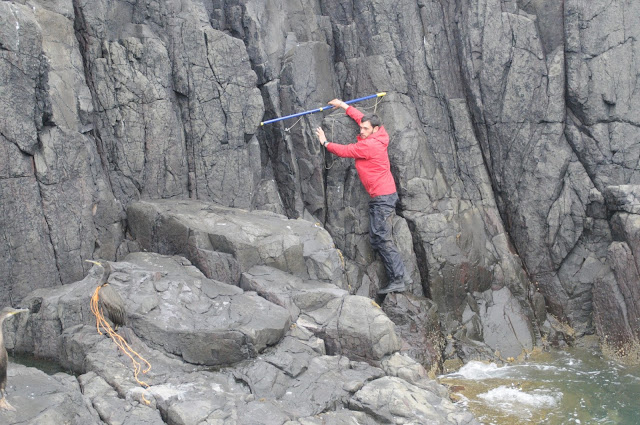
Andy and myself noticed a young Shag with orange twine around its neck. We tried to get it ourselves but every time we got close enough it flew away.
Annoyed with our efforts we called in Rangers to see if they could get it. They asked us where it was last sighted of they went.

You have to give them their due as they tried really hard but once again the shag got away.

A few days later I received a text to say that they had managed to catch the shag and free it of all the twine. What a great result and well done guys for doing a great job.

Another success story for the Farnes.


Friday, 24 July 2015

Noctilucent Clouds over the Farnes

After a great Sunset Cruise on Thursday evening with crystal clear skies and a great sunset I got a text from Gary to say that there is Noctilucent clouds starting to show. I looked at the time and it was about 11pm so I decided to go out and have a look.
I gave my friend Sarah a text to see if she fancied joining me and she jumped at the chance to come out.

We were a little bit lazy and just headed to the harbour so we could have a cuppa while taking some pictures.
The evening was so clear and bright you could see the clouds with your naked eye and they were just amazing witness.

If you don't really know what Noctilucent Clouds are then let me give you a little explanation about them.

Night clouds or noctilucent clouds are composed of tiny crystals of water ice up to 100 nm in diameter and exist at a height of about 47 to 53 miles higher than any other clouds in earth's atmosphere. Clouds in the earth's lower atmosphere form when water collects on particles, but mesospheric clouds may form directly from water vapour in addition to forming on dust particles.

They are most commonly observed in the summer months at latitudes between 50° and 70° north and south of the equator. They can be observed only when the sun is below the horizon and with last night being so clam and clear it was just perfect for it.

I'm not going to go on and on so I will let the pictures show you what they look like.


I hope you like this as I did and if you get a really clear sky in the summer then watch out for this.


Sunday, 19 July 2015

White-beaked Dolphins

We were just about to pick up our guests from the Inner Farne the other day when I noticed a few other boats going the wrong way. When I looked through my bins I noticed they had dolphins around their boats.
Itching to get across and see them I was praying our guests would come back in few minutes quicker. That was never going to happen but when everyone was on board we dashed off to see them.

When we arrived in the area, the dolphins were spread out all over the place and they were obviously feeding. I was not sure which way to go at first so I decided just to go slowly and see what happens.

All of a sudden we were surrounded by them and they were are far as the eye could see.

They were jumping out of the water and they weren't bottlenose dolphins either. They were white-beaked dolphins and what a sight too.

I will guess at about 30 and this has to be a Farnes record too. We did see two near the Farnes last year but not a many as this. The best part about it was that all our guests got a good show and when we returned to Seahouses we had enough time to unload and head back out with more guests and catch up with them.

These beautiful creatures and can grow up to 10ft long and weigh between 180 to 350kg's. They are also very acrobatic and social animals. They will frequently ride on the bow wave boats and jump clear of the sea's surface.

They have been studying these dolphins around the area for some time now and I think they are starting to get a good catalogue of ID's so we can learn a lot more about them.

I love any sort of wildlife but when a dolphin bow rides your boat and leaps clean out of the water you cannot help yourself but smile at these fantastic creatures and what a way to end a trip.


Monday, 13 July 2015

Seabirds Departing

It's that time of the year again when all our seabirds start to depart. Over the last few days we have seen massive gaps on the cliff faces where the Guillemot's used to be and even though the weather was rubbish today you could see loads of jumplings around.
I don't really like this time of the year as you know people will be disappointed when they arrive and everything has gone and the other reason I don't like it, it's because when the gaps start to become big the gulls hang around for the young chicks as they are easy pickings. I know it's nature but it can be cruel at times.

This week has been a very mixed week and no surprise there as its been like this all year. We get a few good days of weather then rubbish again. We never made it out of the harbour on Wednesday and Thursday which was such a pity as it was really sunny and when we did get out on Friday most people were returning home so they never got a chance to see the wonders of the Farnes.

We have also seen good numbers of Purple Sandpipers and Golden Plovers returning to the islands over the last few days. A couple of Great Skua's passing through but over all very quite on the bird front.

We still have lots of seabirds around but they are in their favourite little spots where they tend to go when they are just about to leave. Don't worry they will not be going just yet but its not long now. I would say another 2/3 weeks and that will it for another year, but don't worry we will still be going to the Farnes on a daily bases and hopefully we will see some mega's during that time. We also have been seeing the Bottlenose Dolphins again which is always good.

The harbour has been having some work done to the end of the pier since they found a big hole in it but luckily they caught it in time and it has not stopped us getting into and out of the harbour. They are getting on well with it, and it will not be long before they are finished. They have also found another hole but hopefully they will get a grant or some lottery funding for that as it does need done. The harbour does need some TLC but they are taking silly money to do it. (millions)
One day hopefully.

Also I have to apologise for not posting for a while as my camera and leanse are broken. Both are away at the moment being fixed at the moment, so all I have is my small lense which I use for landscape shots. At least I have something to use but its very frustrating when you see something that looks good and you turn around to pick up your camera and its not there. Hopefully I will have them back soon but in the meantime here is some pictures for you.


Friday, 3 July 2015

Lightning, rain and thunder, we had it all.

What a start to the month. In all my years at the sea this was the worst thunder and lightning storm I have ever seen.
While we were on our last trip on Wednesday we were just about to head across to the Longstone Island when the weather turned for the worst. The skies had turned black and then the heavens opened. We decided to turn back and then all of a sudden the lightning came down with an almighty bang.
Myself and Andy got as many people inside of the wheelhouse and a few under the over hang behind but a few were left outside unfortunately. Andy quickly gave the one's outside some umbrella's in hope that it would help but we were totally caught out by the way it came down. It was coming down so hard that they made no difference at all but, bless Andy he was not going to give up and he held the umbrella to try and stop them from getting wet. It was coming at all angles and the lightning was catching us up very quickly.
We decided to head for the beach but as we got closer and closer to the beach, the lightning was getting closer and closer to us. When your in the middle of the sea without any protection from the elements its definitely squeaky bum time. We made it to the beach and then along the shoreline towards to harbour. Home and without being hit thank god.
The guests got off the boat and I took one look at Andy he looked like a drowned rat and boy did he take one for the team, but to add insult to all the rain he then told me that the lady had also been sick on him too. What a guy and this is what a crewman is all about. A work mate, a grafter and a friend, but best of all he took it in his stride.

After we got home the rain eased and the skies cleared but at 12.15pm it started all over again. The sheet lightning light up the sky and then all of a sudden a massive bang. I heard dogs in the street barking like mad, and then the fork lightning started.

Should I go out or should I stay indoors. Ah stuff it, this might never happen again, so I jumped into the van and drove down the harbour.

The first thing I did was to open the booking office and put the kettle on as it was going to be a long night. The camera was set up and I was ready to go. A few clicks later I was happy with the results and then I started to click away.

A few pictures later a local man arrived. The kettle was back on and  after a hot cuppa and bit of crack we started to take some more pictures. It was 2.30am and I had to be up quick to move the boat in a few hours, so we said our goodbye's and off to bed.

It was not until 10pm that night that I got a chance to have a look at my pictures and I was happy with my first attempt at trying to catch the lightning affect. It was a bit far away but overall I was happy and I even managed to get a moonbow with a bit of lighting in it too. Lucky sod.

Here are the results from the storm.